



Maritime Transport Guide
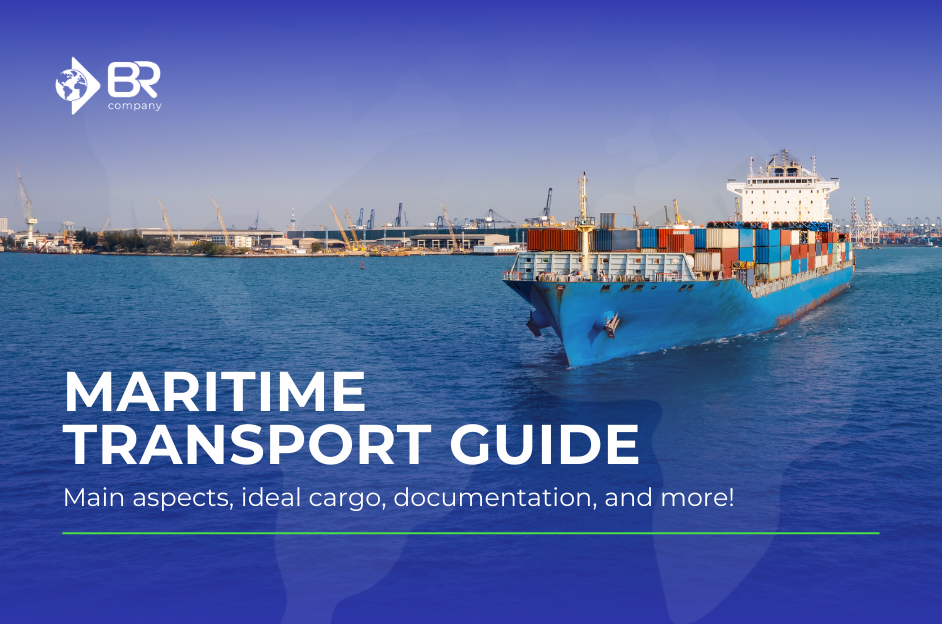
Maritime transport refers to the movement of cargo by ship on ocean routes, rivers, and seas. It is an economical mode of transport, with great versatility and the capacity to transport large volumes of goods over long distances.
See below the main characteristics of maritime transport, including vessel types, essential documents, and the advantages and disadvantages of this mode!
Types of Ships and Cargo
The versatility of maritime transport is reflected in the various types of ships, each designed for specific cargoes:
- Container Ships: Transport goods in standardized containers, the most common in international trade. Ideal for manufactured goods, electronics, clothing, among others.
- Bulk Carriers: Designed to transport bulk cargoes, such as grains (soybeans, corn), iron ore, coal, and fertilizers. They are loaded directly into the ship’s hold. – Tankers: Used to transport bulk liquids such as crude oil, refined products, liquefied gas, and chemicals.
- Ro-Ro (Roll-on/Roll-off) Ships: Designed to transport road cargo, such as cars, trucks, and machinery, which enter and exit the ship on wheels and would not fit in conventional containers.
- General Cargo Ships: Transport various goods that do not fit into the previous categories, such as large projects, equipment, etc.
Essential Documents
Sea transportation has its bureaucratic aspects that are not so different from other modes. Among the main required documents, we can mention:
- Bill of Lading (BL): This functions as a contract of carriage, a receipt for the cargo, and, in many cases, a title deed for the goods. It is the document that certifies the delivery of the cargo to the ocean carrier.
Although similar documents exist for other modes of transport (such as the AWB for air transport), the Bill of Lading is the specific version for maritime transport.
Its unique feature is that it can be negotiable, meaning it can be transferred to a third party, allowing the sale of the goods while they are still in transit. This makes it a credit instrument, a feature that documents for other modes generally lack.
- Commercial Invoice: Issued by the exporter, it details the commercial transaction, including product descriptions, quantities, unit prices, total value, payment terms, and delivery conditions (Incoterms). It is essential for customs inspection.
- Packing List: Document that lists the contents of each volume (box, pallet, etc.) of the cargo, including weight, dimensions, and markings. Essential for customs inspection and clearance.
Stages of the Sea Shipping Process
A sea shipment involves several steps that may not follow a set order, but generally, the maritime transportation of goods occurs as follows:
- Booking: Space is booked on the vessel with the shipping company or freight forwarder.
- Issuance of the Bill of Lading: The shipping company or agent issues the Bill of Lading.
- Collection and Consolidation (for LCL): The cargo is collected and consolidated into a container.
- Transport to the Port: The cargo is taken to the port terminal.
- Shipment: The cargo is loaded onto the vessel.
- Navigation: The vessel travels to the port of destination.
- Unloading and Customs Clearance: The cargo arrives, is unloaded, and goes through the customs clearance process. 8. Final Delivery: The cargo is transported to its final destination.
The Advantages of Maritime Transport
Maritime is the most economical mode for large volumes and long distances, primarily due to its versatility and availability. It has few restrictions regarding the nature of the cargo and, in addition, has a virtually unlimited range, reaching almost every part of the world.
Challenges of Maritime Transport
The biggest disadvantage of maritime transport is transit time, which can be significantly longer than other modes. Maritime also relies on multimodality, relying on land transport to connect ports and final destinations. This mode is also the most affected by congestion and seasonal events.
Count on BR Company for your maritime operations!
Maritime transport is indispensable to the global supply chain, positioning itself as the ideal mode for transporting bulky and non-urgent cargo over long distances.
With the support of experienced logistics partners like BR Company, your cargo gets where it needs to go safely and efficiently.
Contact us!

Related posts
House Bill of Lading vs. Master Bill of Lading: Understand the differences and their legal and operational implications in international transportation
In international logistics, the Bill of Lading (BL) is one of the most important
What is ICMS?
ICMS is a state tax levied on the circulation of goods and the provision of cert
Integrated Logistics: What is it and why invest?
In foreign trade, supply chain efficiency is a determining factor for company su

Leave a Reply