




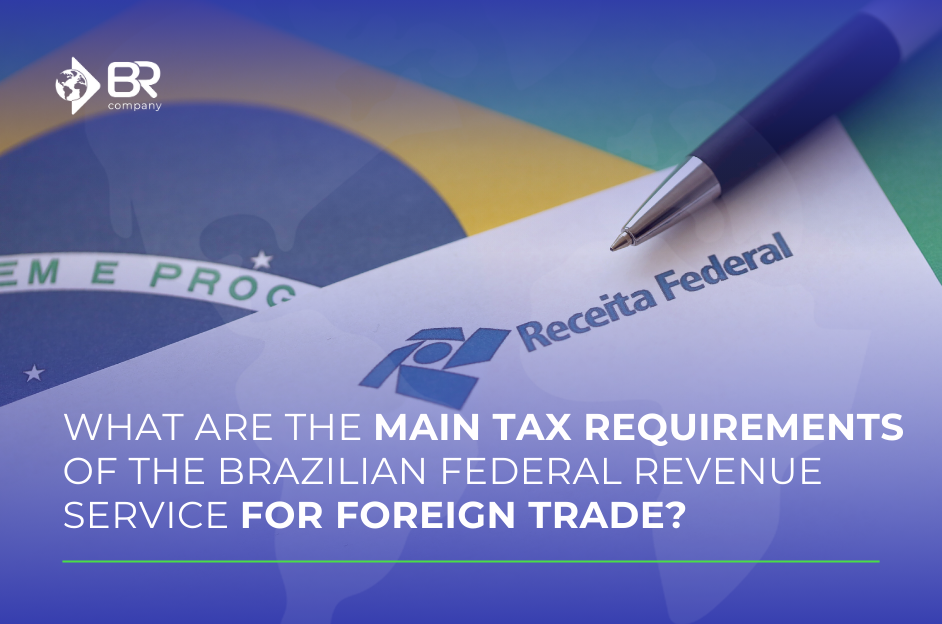
What are the main tax requirements of the Brazilian Federal Revenue Service for foreign trade?
The Brazilian Federal Revenue Service’s role in foreign trade is fundamental to guaranteeing legal security, customs control, and tax compliance in import and export operations. For companies operating in the international market, understanding these requirements is essential to avoid fines, delays, and the seizure of goods.
Below, we have compiled the main points to consider to keep your operations aligned with Brazilian regulations.
1. Company’s tax compliance
Before any operation, the Brazilian Federal Revenue Service requires that the company’s tax situation be regularized. This includes an active CNPJ (Brazilian taxpayer identification number), absence of tax arrears, and proper classification within the tax regime. Companies with irregularities may have their declarations blocked or suffer restrictions in Siscomex (Brazilian Integrated Foreign Trade System).
2. Radar/Siscomex Registration
To import or export, it is mandatory to obtain Radar registration, a system that authorizes access to the Siscomex Single Portal. The Brazilian Federal Revenue Service assesses the company’s financial capacity, size, and tax history to determine the type of authorization (Express, Limited, or Unlimited). Without this step, no transaction can be registered.
3. Correct Tax Classification (NCM)
The tax classification of goods, using the NCM – Mercosur Common Nomenclature, is one of the most sensitive aspects of foreign trade. The Revenue Service uses the NCM to determine taxes, administrative procedures, licensing requirements, and controls by regulatory bodies. Errors in classification can lead to fines and mandatory reclassification.
4. Compliance with ancillary obligations
The Brazilian Federal Revenue Service requires a series of mandatory declarations, such as:
- DUIMP (Single Import Declaration)
- DU-E (Single Export Declaration)
- Cargo Manifest
- Customs Value Information
These documents must be completed accurately, as inconsistencies can result in tax demands, audits, and delays in customs clearance.
5. Correct payment of taxes
In imports, the Federal Revenue Service monitors the collection of taxes such as II, IPI, PIS-Importation, Cofins-Importation, and ICMS. In exports, although most taxes are exempt, the company must correctly prove its eligibility to benefit from tax incentives. Undervaluation or overvaluation of goods is one of the main points of inspection.
6. Origin Control and Documentary Verification
The Revenue Service also verifies certificates of origin, commercial invoices, packing lists, contracts, and transport documents. Missing documents or discrepancies between them may result in cargo retention and the initiation of a special inspection procedure.
7. Compliance with Special Customs Regimes
Companies using regimes such as Drawback, Temporary Admission, Customs Warehouse, or Blue Line must comply with specific rules and maintain up-to-date documentation. Non-compliance may result in retroactive tax collection and penalties.
Count on BR Company!
The tax requirements of the Federal Revenue Service in foreign trade are broad and detailed, demanding constant attention from companies. Maintaining compliance not only avoids risks but also ensures faster, more predictable, and competitive operations in the international market.
BR Company offers comprehensive support in logistics, customs clearance, and compliance to ensure your company operates safely and efficiently in 2026 and beyond. We are ready to support every step of your global operation.

Related posts
What is ICMS?
ICMS is a state tax levied on the circulation of goods and the provision of cert
PTAX in Foreign Trade: Everything Importers and Exporters Need to Know
What is PTAX? PTAX is the official exchange rate calculated daily by the Central
House Bill of Lading vs. Master Bill of Lading: Understand the differences and their legal and operational implications in international transportation
In international logistics, the Bill of Lading (BL) is one of the most important

Leave a Reply